
Admitting that you don’t know something is honest, brave and often the best option. Why we should risk looking foolish more often.
‘The man who asks a question is a fool for a minute, the man who does not ask is a fool for life.’
Confucius
Reading Time:
In general, we enjoy learning new things and feeling wiser. At the same time, we often find it hard to admit that we don’t know something. We prefer to hide our ignorance rather than risk looking foolish.
However, by hiding our ignorance and avoiding asking questions we miss the opportunity to learn and grow, as well as to better connect with people. Here’s how we can learn to take more risks in our professional and personal lives.
The Temptation To Avoid Looking Foolish
We’re going take a look at admitting ignorance in the workplace, because it’s a great example of human interaction in groups.
The fear of looking foolish
There can be a reluctance in a workplace setting to admit “I don’t know” because of the fear that this will be interpreted as saying “I am an incompetent fool who does not deserve this job. I should go pack my personal items into a box and take my sorry self home.”
Now to be fair, a workplace should contain the relevant expertise. No-one wants to go to a doctor and be told “Honestly I have no idea why you are having chest pains. What do you think?” I am not talking about the times when you really should know the answer (as in, it’s your job to know). I am referring to the times when you genuinely don’t know something but are reluctant to ask.
Am I the only one that’s confused?
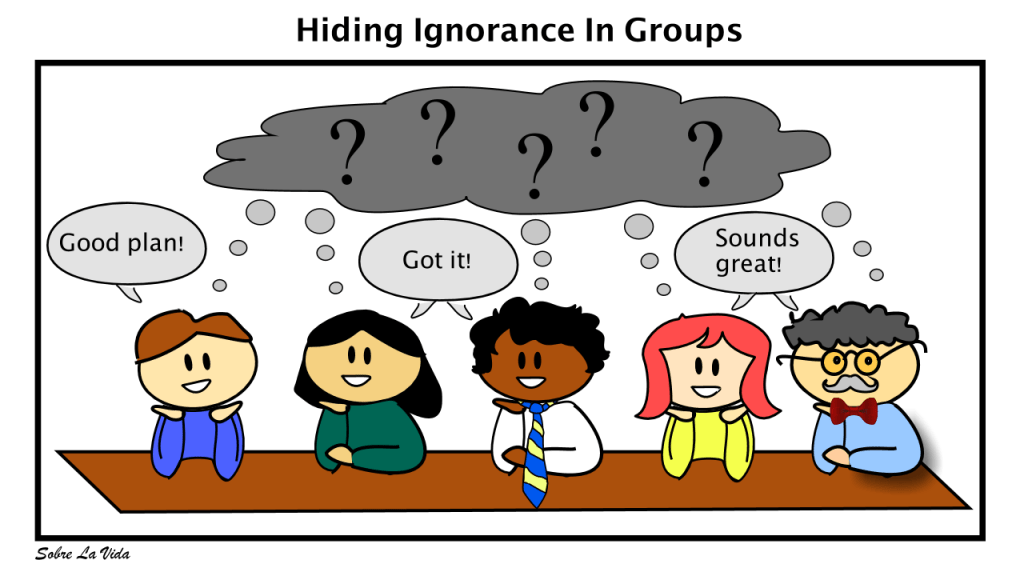
At times we are afraid to admit ignorance in a group setting because we assume (often wrongly) that we are the only ones who are confused.
This can be illustrated in corporate meetings where everyone is nodding enthusiastically, although in reality no-one is sure what is being decided. However, if someone has the courage to say “Sorry, but I’m confused. Please clarify“, it is likely they find they are not be the only one confused. It was just that people felt foolish saying, “It sounded reeeally great boss, but umm… eerrr… what do you mean exactly?“
We each assume that we are the only one confused and that everyone else understood what was going on (in psychology this is referred to as “pluralistic ignorance”). Likewise, the boss assumes everyone understood because no-one asks questions.
The pressure of being in groups can increase the temptation to remain in ignorance, rather than risk looking foolish by asking questions.
The problem with being afraid to admit your confusion is that you (and everyone else) remain in ignorance. The only way to get more clarification is to ask for it. Further, asking earlier is better. It is easier to ask for clarification on something said earlier today, than to admit to your boss that you’ve been confused about a project for the last 6 months.
How admitting ignorance creates trust
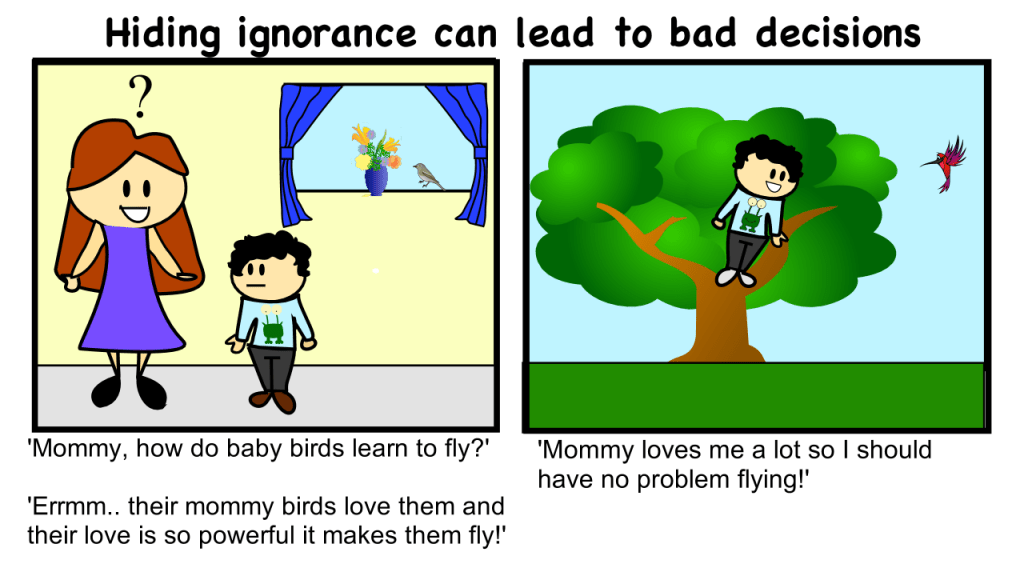
If someone admits when they don’t know something, you have more confidence when they tell you what they do know. By contrast, covering up or lying about ignorance can lead to decisions based on bad information and destroy trust.
Making Asking a Habit
‘The only true wisdom is in knowing that you know nothing.’
Socrates
Asking questions and admitting ignorance is useful in all aspects in life, both professional and personal. It’s the way we learn and growth.
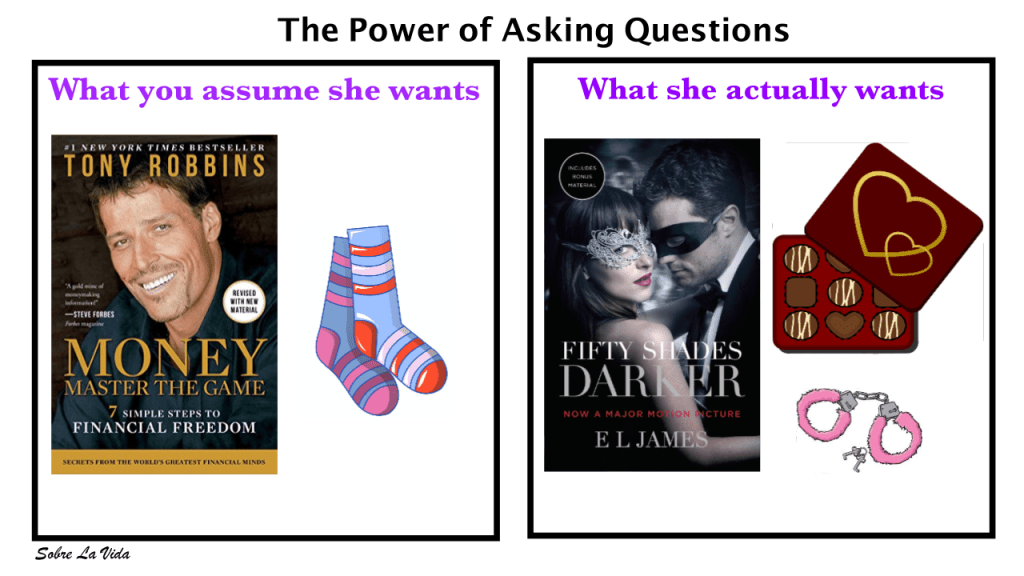
Learning to admit “I don’t know” applies to situations when we are too embarrassed or proud to ask because we think you should already know. We also need to learn to recognize when we’re simply making assumptions, rather than asking to find the real answer.
The openness to admitting that (i) you might not know something or (ii) something that you assume you know may not be correct, brings opportunities for learning and growth. It also leads to better understanding the people that matter to you.
Becoming Wise Through Looking Foolish
Admitting that we don’t know something can be hard. It takes vulnerability and therefore courage. It means moving out of the comfort zone of certainty into the territory of the unknown.
It is worth remembering that asking questions is something that you can get better at. You can learn to cultivate an attitude of humility and open curiority. When faced with uncertainty, instead of rushing to defend yourself or hide your ignorance, you can choose to see it as an opportunity to learn and grow.
The people that are really good at asking a lot of questions are often some of the wisest people around. So be courageous and risk looking foolish in order to become wise.
‘The greatest gift is not being afraid to question.’
Ruby Dee

 Sobre La Vida