
While the news media tells us the world is a disaster, social media suggests people are still having the time of their lives. How to make sense of these two conflicting views.
Reading Time:
Tuning into the news these days can feel overwhelming. Take your pick of concerns: war, inflation, unchecked technological growth, political polarization, prejudice, poverty, exploitation, climate change and so on. Any one of these is enough to cast a shadow over your outlook on life.
And yet, if you look at social media, it often appears that people are still having the time of their lives. Travelling, showcasing their latest looks, enjoying amazing food and social lives.
Experiencing this contrast can evoke anything from mild envy (FOMO) to a deep sense of confusion. Should you:
(i) sink into despair about how AI will soon be doing your job better and cheaper than you, while the ocean rises to swallow your home, or
(ii) simply relax and remember that everything is awesome!
Let’s explore both perspectives.
Social Media:


News Media:

The Super Positive View – Everything is Awesome!
“Everything is awesome when you’re living out a dream.”
The Lego Movie
Much of social media – as well as the entertainment and advertising industries – encourages the idea that life is, or should be, awesome.
Awesome vacations.
Awesome food.
Awesome outfits.
Awesome social life.
Everything is awesome. Drink overpriced coffee at $37? Awesome!
Lacking something in your life? No worries. Much “awesomeness” can be purchased or optimized. You can upgrade your look, your skills, your relationships, even your spiritual life. Also at your service are any number of celebrities, influencers and role models ready to inspire you to become more awesome.
Everything is available for sale towards a More Awesome You.
Don’t get me wrong. I like awesome as much as the next person. It is good to enjoy our lives. The danger is when we slip into the shadowy abyss of believing that life should always be awesome. Then we feel bad about ourselves when it isn’t. And resentful towards others who seem to be higher on the awesomeness scale. We ask ourselves: “Why am I not as awesome as everyone else?”
Social media amplifies this dynamic by encouraging us to selectively showcase parts of our life – the moments where we look amazing, say super witty things and are having a great time. Our idealized self living an idealized lifestyle.
“May your life someday be as awesome as you pretend it is on Facebook / [insert your favorite social media].”
This selective sharing is understandable. Posts of you looking fabulous in fabulous places generate Likes, which you like.
A post of you in pajamas in front of the television feeling depressed about your life? Much less likes. Possibly some unfollow requests as well. Less awesome.
Less popular social media updates:
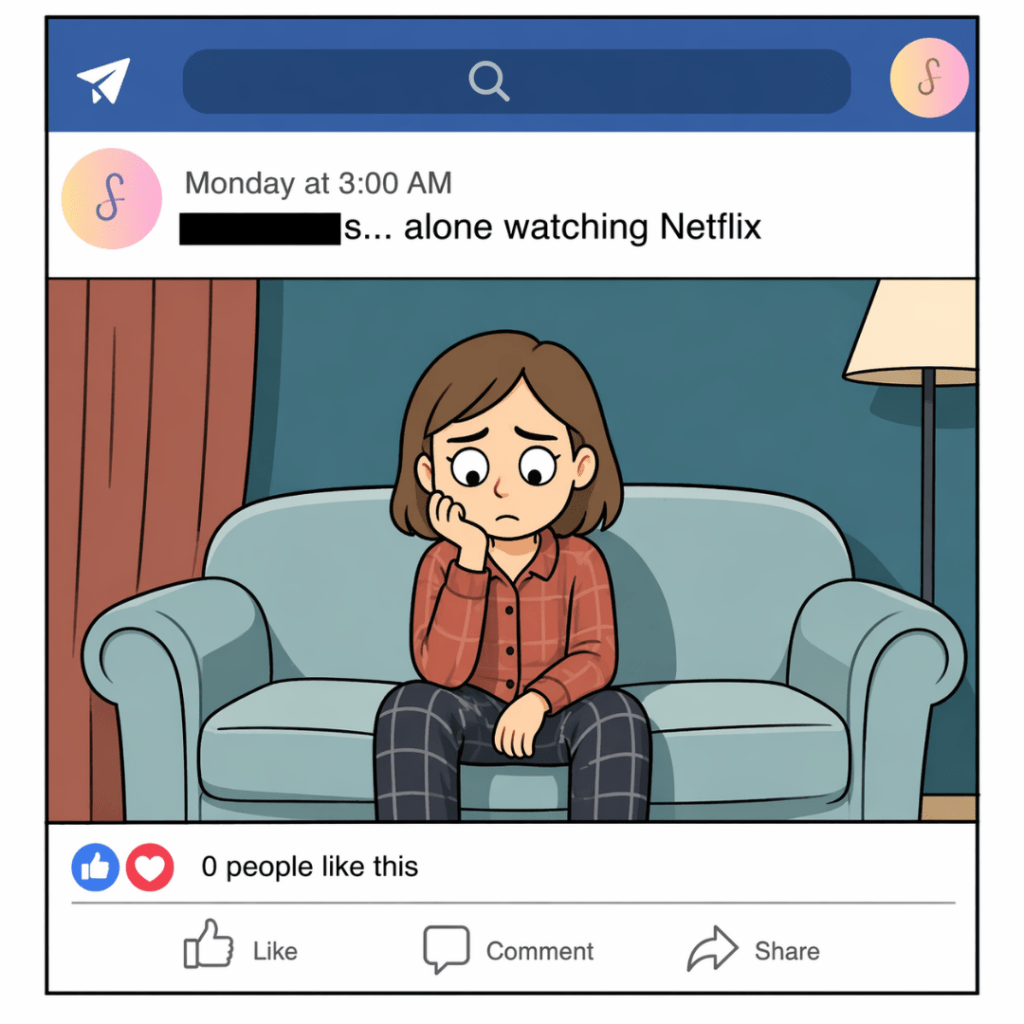
Digital media allows us to communicate with people and share our lives in a way that was previously not possible. However, despite our hyper-connectivity, there is an increasingly widespread sense of loneliness and isolation. Part of this comes from comparing ourselves to what is being published by others.
“Comparison is the thief of joy.”
Theodore Roosevelt
When we measure our real, complex lives against the curated highlights of others’ “Perfectly Instagrammable Moments” and “Super Hilarious TikTok Reels”, we lose perspective. In real life everything is not always awesome. It includes boredom, confusion, struggle and imperfection.
To be our authentic selves requires letting go of hiding or feeling ashamed about our so called “bad” parts. If we hide these parts in order to appear more awesome, we create a false image of ourselves. We then look around and see the projected false images from others, while they hide their own “bad” parts. We feel isolated and alone because we have lost authentic connection with ourselves, as well as with others.
To be authentic does not mean to publish, play-up or act out our “bad” parts. It means allowing ourselves to feel more whole through accepting our non-perfections and complexities. We can then accept the imperfections of others, because we are grounded in our own completeness.
The All Out Negative View – The World Is A Disaster
“Everything’s not awesome
The Lego Movie 2: The Second Part
Everything’s not cool
I am so depressed”
At the other extreme, it can be easy to fall into the belief that the world is anything but awesome. Much of the media not devoted to awesomeness is full of content reflecting the darker side of humanity – conflict, crisis, division and suffering. Adding to this, digital platforms make it easier to spread hatred, polarization, and “us vs them” mentality. The result is a world that feels overwhelming and hostile.
The challenge here is different.
It is to build the capacity to keep our hearts open – to the beauty, potential and goodness of life – even while acknowledging the ugliness, difficulty and distortions. This requires compassion and empathy: for ourselves and for others, without feeling that life is against us.
To stay centered in a turbulent world, it’s helpful to be aware of three reactive, fixed mindsets* that can pull us into conflict:
- (i) feeling hopeless and persecuted by life,
- (ii) blaming life for not being what we want it to be,
- (iii) believing we must fix or rescue everything.
*These patterns are also known as the “drama triangle” with the roles of victim, persecutor, and rescuer.
Each of these three fixed reactive mindsets overlooks personal agency and instead seeks solutions through controlling and changing others. The reality is that we cannot control and change others and therefore these mindsets lead to an endless conflict. A healthier attitude towards life begins with the acceptance of what we can and cannot change. This gives us a solid grounding from where we can respond more creatively and effectively to build the life we want.
“May I be granted the serenity to accept what I cannot change, the courage to change what I can, and the wisdom to know the difference.”
Serenity Prayer
Lastly, if the news feels overwhelming, it is worth remembering that just as social media “likes” are not generated by publications of saggy trackpants with bad hair days, news is not sold through reporting on the boring. The news is biased towards headline grabbers, which are often dramatic and negative.
News that doesn’t sell:

Finding The Middle Ground – The Awesome And The Terrible
“Everything’s not awesome
The Lego Movie 2: The Second Part
But that doesn’t mean that it’s hopeless and bleak..”
The reality is that our world contains both the awesome and the terrible, as well as all things in between. Earth is a challenging mix of heaven and hell. To live in harmony with reality is to move beyond a black-and-white view (the world is either all good or all bad) towards allowing all the colors, including the many shades of grey.
By opening ourselves to the full spectrum of experience, we stop participating in a dualistic stance that leads to divisiveness and polarization. Trying to fight negativity (by blaming, feeling victimized or needing to compulsively fix it) only adds to it. Pretending negativity does not exist and that everything is awesome creates a false life and cuts us off from parts of ourselves.
Through accepting a spectrum of darkness and light, we can take personal responsibility for how we are showing up in the world. We can look inward and ask:
– How is what affects me negatively in the outside world reflected in my own personal life?
– What steps, however small, could I take towards change?
This kind of reflection allows us to uncover our internal resources and wisdom. And in doing so, we contribute our unique color and light to a world that at times finds itself shrouded in shadows.
“Be the change you want to see in the world.”
🩷🧡💛💚🩵💙💜🩶❤️


 Sobre La Vida