
Whether related to harmful addictions, toxic relationships or other unhealthy situations, here’s why we make bad choices when we should know better.
Reading Time:
Having navigated the stormy seas of adolescence to reach the sunny lands of adulthood, you shouldered the mantle of maturity and assumed the crown of wisdom. Henceforth, you forever ceased to make bad decisions in situations where you should have known better.
Sound like you or anyone you know? No need to answer this one. Unless you personally know the Dalai Lama (in which case I’d appreciate an introduction).
It is easy to spot red flags in potentially disastrous situations when it comes to other people. We watch with foreboding as a friend gets further sucked into a toxic relationship or as a colleague starts to drink heavily. However, with respect to our own potential bad choices, we walk right through those red flags. We claim not to see them or insist that they only apply to other people.
Should we chalk up our propensity to act foolishly to the fact we just haven’t evolved all that much from our prehistoric ancestors? Or is there a reason we like to learn things the hard way?

The Reasons We Make Bad Choices
Here are 7 key reasons for why we make bad decisions when we really should know better.
1) Knowledge vs Experience
“By three methods we may learn wisdom: First, by reflection, which is noblest; second, by imitation, which is easiest; and third by experience, which is the bitterest.”
Confucius
Confucius could have added “and most memorable” to the part about learning from experience. You know how telling a child not to touch the hot stove is never as unforgettable a lesson as actually touching the hot stove?
Knowing something intellectually is not the same as experiencing something in reality – that is emotionally, physically and sometimes viscerally.
That’s why watching a movie about toxic love is not the same as actually having your heart broken (and stomped all over). And why seeing your friends make bad decisions is not the same as making those same bad choices yourself. Which is ok. We don’t want to gain all of our wisdom from reading books and watching our friends make fools of themselves. We need to make our own mistakes too. We need at times to touch the hot stove, even knowing better. Experience can be a necessary (if hard) part of learning.
“Sometimes the wrong choices bring us to the right places.”
The problem is when we have already touched the stove a number of times. We have felt it burn us, but we still want to touch the next stove thinking the experience will somehow be different:
“No really, this stove is different! I’ve learned to touch it better! And it has promised to work on the burning-me issue.”
Yeah. Right.
But let’s face it, we all have our version of the stove we can’t stop touching. So why do we keep repeating the same bad choices believing that this time will be different?

2) When Emotions Hijack Reason
“The brain is the most outstanding organ. It works 24/7, 365 from birth until you fall in love.”
Sophie Monroe
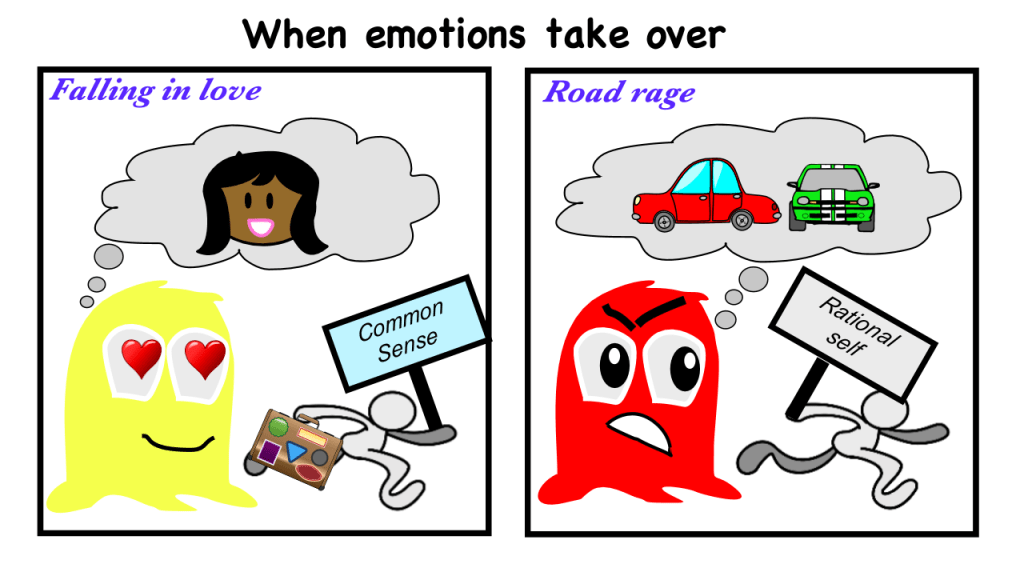
It’s true, your rational self works just great… until your emotions stage a coup and take over.
Falling in love? Watch as Common Sense packs its bags, wish you luck and exits stage left.
Suffer from road rage? Watch the rational part of your brain shut down as you convert into a screaming, horn blowing maniac once stuck in traffic.
Why is it that our emotions have so much impact on our behavior? Firstly, it helps to understand that emotions are generated in a distinct area of our brain that evolved long before the rational thinking part.* Emotions have always been a essential part of our survival and are capable of causing us to react even before we have a chance to think. That’s why you jump back upon seeing a snake before you’ve even consciously registered fear. Or when someone cuts you off in traffic you let loose a dirty word in front of your kids before you have time to self-censor.
Secondly, emotions are accompanied by chemicals and hormones that flood our bodies and induce us to react in certain ways. For example, falling in love produces a cocktail of intoxicating chemicals which make us feel good and crave more time with the source of our infatuation.
Our emotions are ancient and powerful. As such, in order to stop repeating undesirable patterns of behavior, the underlying emotional causes need to be recognized and managed.
Emotions that are not processed often remain trapped in the body, resurging when triggered by certain events. For example, recurring road rage may simply be an excuse to release stored anger that relates to an unpleasant past experience. To break this habit you need to access and manage the underlying emotions that have not yet been processed.
* The emotional part of our brain is referred to as the limbic system (which includes the amygdala, a key part of our emotional hardware) and the rational part is referred to as the prefrontal cortex.
3) Short-Term vs Long-Term tradeoffs
To anyone who has not had the experience of waking up with a pounding head, dry mouth, heaving stomach and the thought “WHY did I not stop at a couple beers last night….. instead of 9..and those two shots of tequila?”, I congratulate you on your self-control.
In life we are constantly deciding between short-term and long-term trade-offs. That delicious chocolate cake today is extra kilos for Future “Can’t Fit In My Pants” You. That passionate kiss with your colleague at tonight’s office party is the beginning of painful and expensive legal proceedings for Future “Getting Divorced” You. Deciding to forgo your monthly shopping spree is more financial security for Future “Happily Retired” You.
Unfortunately, when we calculate long-term trade offs we often don’t do the maths well. One reason is because the “here and now” is much easier to imagine, as opposed to the distant and less predictable future. It can be difficult to delay gratification in the moment (that sweet sweet rush of sugar) only for the potential future downside, which may not even happen. This is especially the case if we engage in some “innocent” self deceit. “I’ll definitely go to the gym six times this week to work off this chocolate cake.’
The attraction of “here and now” is even stronger when it is based on emotions or substances that affect the chemicals in our brains (mmm….. sugar and beer). These tend to override our longer-term, more rational self.
At times it makes sense to enjoy what you have now without worrying about the future trade offs. For example, it is better to seek work-life balance now, instead of slaving away in the office during your youth only to reach retirement when you’re too old and worn-out to enjoy it.
Similarly, making not so sensible short-term decisions is ok if done in moderation. The times we drank too much, went out too late and ate too much are often the moments which make our lives interesting and memorable.
“No-one looks back on their life and remembers the nights they got plenty of sleep.”
However, if you are in the habit of making your decisions based on short-term gratification, you are likely sabotaging your longer-term well being. A good decision is one that takes into account both short term and long consequences.

4) Because You “Want” To
Although most people would say that they do not deliberately make bad choices, at some level (often unconsciously) a part of us does want to make that choice. Even a seemingly bad choice may serve an underlying “positive” purpose, in the sense of being a solution to something. For example, drinking or eating to excess could have an underlying purpose of distracting us from an even bigger problem in our lives such as a fear of intimacy or a deep sense of unworthiness.
If you find yourself repeating bad choices that lead to harmful behavior, finding the true underlying reason for this behavior will help in breaking the pattern. You can ask yourself “What would happen if I stopped this behavior?” – that is, what else would you have to face up to if it weren’t for this behavior?
5) Old Habits Die Hard
Human beings are creatures of habit. We tend to favor the familiar and often operate on “auto-pilot” as we execute our daily routines. Where bad choices become embedded into habits, it is much more difficult to change them and much easier to just keep making the same choices. It requires time, dedication and discipline to establish a new habit that makes better choices.
The good news is that in doing this successfully, you can then revert to “auto-pilot” and no longer need to worry about re-making the same habitual bad choices.
6) There’s Still A Lesson To Learn
“Those who do not learn from history will continue to repeat it.”
Until you learn from your bad choices, you’re likely to keep repeating them. Even when we think we have learned the lesson, if we continue to repeat the same mistake it is because we still have something left to learn.
One of the biggest lessons we need to learn is that the compulsion to repeat bad choices often originates in emotional wounds that we have not yet healed. Something in our past wounded us and we compulsively seek out similar situations in an unconscious attempt to find a cure in the situation, rather than seeking the cure within ourselves.
This type of pattern is illustrated where someone continues to have toxic relationships. Each relationship wounds the person more, yet they continue to seek similar relationships with the belief that this next relationship will be the one that works out and cures all.
The reality is that no-one can heal our wounds but ourselves. Further, until we recognize our own wounds we cannot start the healing process. Instead we will continue to repeat old patterns and make the same bad choices.
7) You’re in Denial
“By not admitting your mistakes, you are admitting you will repeat them in the future.”
Ah yes. Denial is not just a river in Africa. It’s the refusal to recognize that a choice was a mistake. Denial will pave the way for you to keep making the same bad decisions over and over.
It’s not easy to take responsibility for a bad decision. Admitting we were wrong requires vulnerability and therefore courage. However, by recognizing a bad choice, it becomes an opportunity to learn instead of repeating the same mistake.
Bad Choices – The Healthy, The Unhealthy & The Toxic
Not all bad choices are created equal. Bad choices can be healthy when they allow us to learn and grow. Further, some bad choices do not cause real harm and instead illustrate that moderation rather than perfection is the key to enjoying life. “Another slice of chocolate cake? Well I’ve just finished my 3rd…. so yes please!”
The unhealthy bad choices are the ones we continue to repeat unnecessarily without any learning or growth. The toxic bad choices are the ones that we not only repeat but that cause substantial harm to ourselves and the people around us.
Facing up to our mistakes in making choices and endeavoring to do better can be uncomfortable and challenging. However those who have the courage and perseverance to do so will find themselves greatly rewarded.
“The successful man will profit from his mistakes and try again in a different way.”
Dale Carnegie
 Sobre La Vida